
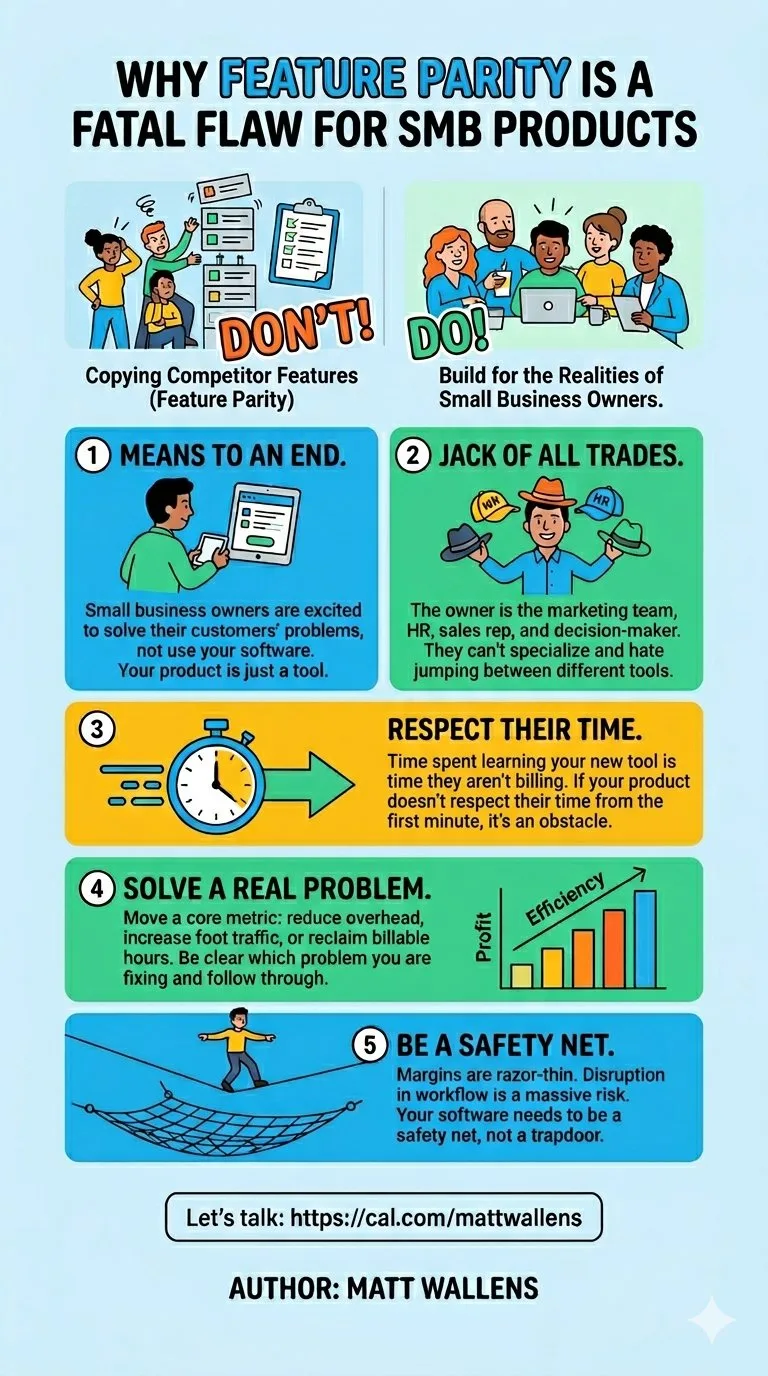
Here’s something I see way too often in product conversations: a team points to their competitor’s feature list and says, “we’ll match everything they do.”
In the enterprise world, feature parity might get you through a procurement checklist. In the consumer world, a slick UI might win a download.
But small business owners don’t behave like a teenager looking for the latest trendy water bottle, and they don’t act like an exec at a Fortune 500 company. The person writing the check is the same person who has to live with your product every day. When you’re building for small businesses, being “just as good” as the competition isn’t enough. To a small business owner, change isn’t a minor inconvenience. It’s a massive risk.
Some realities of building for small business owners:
Your software is a means to an end
Small business owners don’t wake up excited to use your software. They’re excited to solve their customers’ problems. Don’t kid yourself that your product is anything more than a tool they use to get there.
They’re wearing every hat
The person you’re building for isn’t sitting in a dedicated role with a single job description. They’re the owner, the marketing team, the HR department, the sales rep, and the decision-maker. Sometimes all before lunch. They don’t have the luxury of specialization, and they don’t want to jump between tools all day.
Time is money, literally
For a shop owner or service provider, time spent learning your tool is time they aren’t billing. If your product doesn’t respect their time from the first minute, it’s an obstacle. They don’t have time to sift through noise to find the signal.
Solve a real problem
If your product doesn’t directly move a core metric — reducing overhead, increasing foot traffic, reclaiming billable hours — they won’t find a place for it. Be clear about exactly which business problem you’re fixing, and follow through on that promise.
Margins are razor-thin
Most small businesses operate on a tightrope. They don’t have a corporate budget and can’t absorb financial mistakes. A disruption in their workflow isn’t just a headache: it can mean bills don’t get paid or payroll isn’t met. Your software needs to be a safety net, not a trapdoor.
If you’re building for the people who run the local shops and services we rely on, let’s make sure your product strategy matches their reality. Let’s talk.